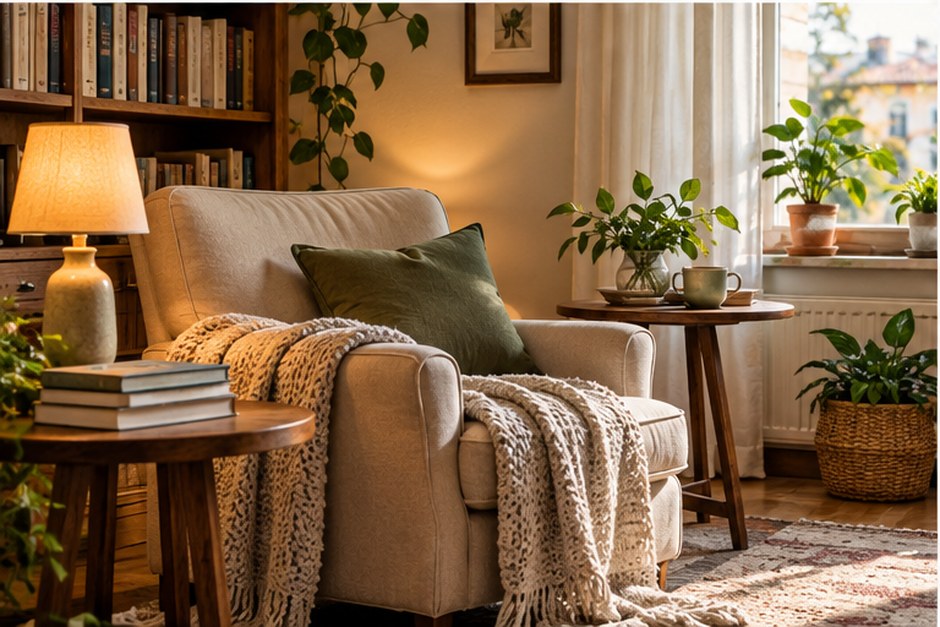
How to Build a Reading Corner You Actually Use
A reading corner does not need to look like a photograph from an interiors magazine. It needs to make opening a book easier than checking something else. That usually comes down to a few practical details: a chair you can sit in for forty minutes, light that reaches the page, a place to put a drink, and books close enough that choosing one does not become a separate task.
The most useful reading spaces often begin with furniture already in the room. Before buying anything, notice where you naturally sit when you want quiet. A corner near a window, the end of a sofa, or a chair beside a bookcase may already have most of what you need.
Choose comfort by time, not appearance
A chair can look inviting and still become uncomfortable after ten minutes. Test the way you actually read. If you tend to tuck one leg underneath you, make sure the seat is wide enough. If you read upright, check that the back supports you without pushing your head forward. If you like to curl up, an ottoman or small footstool may matter more than extra cushions.
Do not aim for lounge-chair softness if it makes you sleepy every time you sit down. A slightly firmer seat can be better for daytime reading because it supports a stable posture. A throw or cushion can always make it softer when you want a longer evening session.
Light the page rather than the whole room
Natural light is pleasant, but it changes through the day. A good reading corner needs a dependable lamp as well. Position it so the light falls across the page without shining directly into your eyes. For most people, a lamp placed slightly behind and to the side of the shoulder works well.
A small pool of light also helps define the corner psychologically. When the rest of the room is dimmer, the chair and book become the focus. You do not need a dramatic statement lamp; an adjustable floor lamp or compact table lamp is often more practical.
Keep the next book within reach
Reading momentum is fragile when finishing one book means searching through shelves for the next. Keep two or three possible choices near the chair. They can sit on a side table, a small shelf, or even a tidy stack on the floor if that suits the room.
It helps to mix formats. A novel, an essay collection, and a photo book ask for different levels of attention. On a tired evening, a book you can browse for ten minutes may keep the habit alive better than forcing yourself through a dense chapter.
Give small objects a permanent place
Reading corners attract things: glasses, bookmarks, tea cups, pencils, chargers, and half-finished notes. Without a place for them, the area quickly becomes cluttered. A shallow tray or small box keeps the surface usable while letting those objects stay nearby.
If you annotate books, keep one pen in the corner rather than carrying a whole stationery collection. If you read with a drink, use a side table that is stable and easy to reach without leaning awkwardly. The best setup is the one that removes repeated little interruptions.
Reduce the competition
A reading corner cannot force attention, but it can make distraction slightly less convenient. If the chair faces a television or work desk, try angling it away. Keep the phone on a shelf behind you rather than in your lap. Even a small change in orientation can make the corner feel like a different activity zone.
Sound matters too. Some readers like quiet; others focus better with low instrumental music or ordinary household background noise. The point is not to create perfect silence, but to find an environment you can return to consistently.
Let the space evolve with your habits
Use the corner for a week before deciding what is missing. You may discover that the chair is fine but the lamp is too weak, or that you need a footstool more than another shelf. Perhaps the table is too low, or the window creates glare in the afternoon. These are easier problems to solve once you have actually spent time there.
Personal touches can come later. A plant, framed print, small rug, or favourite blanket makes the space feel settled, but none of these is as important as comfort and light. The goal is not to create a display. It is to create a place that quietly invites you to sit down.
When a reading corner works, you stop thinking of it as a project. It simply becomes the chair where books happen. That ordinary familiarity is more valuable than any perfect arrangement.